Challenges of ML
Machine Learning is a techonique to learn rules from examples (the data) automatcially. Thus there are mainly two important things to deal with:
- data (the examples)
- algorithms (how to learn rules)
Most works of ML project are to resolve the challenges : bad data, bad algorithms, performance, and so on.
Bad Data
- Nonrepresentative training data. (sampling noise & sampling bias)
- Poor-quality data (outliers, errors, noise) solution: data cleaning
- Irrelevant features. solution: feature engineering
Bad Algorithms
Bad algorithm means that the model has the overfitting and/or underfitting issue.
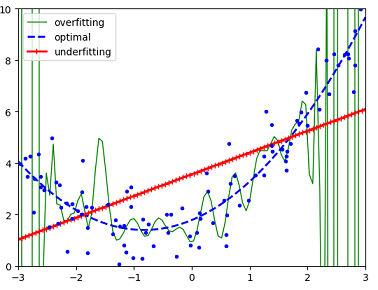
Suppose we have a data set generated using a quadratic model with gaussian noise. The following picture shows these issues. The optimal model best fits the training data.
Underfitting the training data
It occurs when the model is too simple to learn the underlying structure of the data. Thus the model performs badly on the training data. Performance measure tells how to evalute the performance of a model.
Solutions:
- select a more powerful model
- feed better features (feature engineering)
- reduce the constrains on the model
The Improvement page shows how to improve the performance of the model.
Overfitting the training data
Overfitting means that the model performs well on the training data, but it does not generalize well to new cases.
It happens when a complex algorithm detects subtle patterns that are not real or only belong to the training data. For example:
- training set is noisy: errors, outliers and noise (e.g., Gaussian noise)
- sampling noise because of small sampling (i.e., nonrepresentative data)
- pure chance: e.g., “category names” of “category” feature have some pattern
Solutions:
- simplify the model: fewer params, fewer attris, constraining the model
- gather more training data
- reduce noise in the training data
- by some strategy, e.g., early stopping
The strategy method will be discussed here and others will be discussed in other pages.
Learning Curves
How can you tell whether your model is overfitting the data or underfitting the data?
If a model performs well on the training data but generalizes poorly according to the cross-validation metrics, then the model is overfitting. If a model performs poorly on both, then it is underfitting. This is one way to tell when a model is too simple or too complex.
Another way to tell is to look at the learning curves : these are plots of the model’s performance on the training set and validation set as a function of the training set size. The following picture shows the learning curves of the linear model and 10-th degree polynomial model.
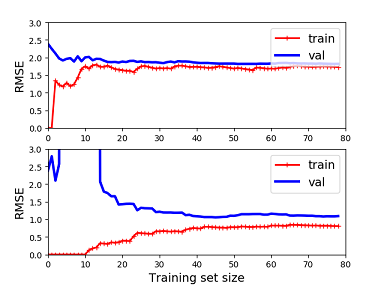
The above picture shows that it has a high bias, which means that the model underfits the training data. The below picture shows that the bias is low but there is a gap between the curves, which means that the model overfits the training data.
Reduce Overfitting issue by Strategy
We can find ways to “reduce” the subtle patterns that only belong to the training data, or preclude the model from learning these patterns.
Ensemble Learning helps for this task. A Random Forest is an ensemble of Decision Trees, generally trained via the bagging method (or sometimes pasting). Bagging introduces extra diversity in the subsets that each predictor is trained on, and extra diversity means that the unexpected subtle patterns are somewhat “reduced”, so the ensemble’s variance is reduced.
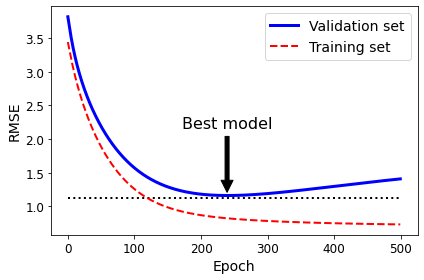
We can also stop the training process before the model learns these patterns. The method is called early stopping. It works for the algorithms that learn rules gradually.
The iterative algorithms Gradient Descent gradually tweaks the model parameters to minimize the cost function over the training set. It iteratives the training set many rounds (each round is called an epoch) to detect patterns existing in the trainin set. Many more rounds of iteration means many more patterns will be learnt. However, it also means that the subtle patterns that only belong to training set will also be learnt. Thus the learning process shall be stopped earlier.
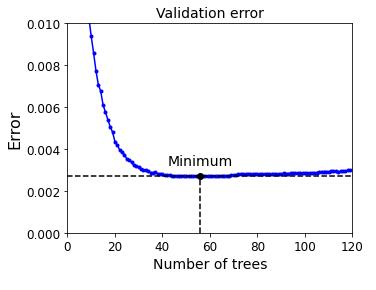
Another example is the Boosting algorithm. It refers to any Ensemble method that can combine several weak learners into a stronger learner. The general idea of most boosting methods is to train predictors sequentially, each trying to correct its predecessor. More predictors means more patterns are learnt, but it also increases the risk of overfitting. Thus we shall control the number of predictors.