Performance Measures
We evaluate the regressor with RMSE (Root Mean Square Error) introduced in the Cross Validation page. But it is a different story to evaluate a classifier.
Suppose we have the MNIST dataset that contains images representing 0~9 digits. And we create a binary classifier that can tell whether or not an image is the digit 5. And then check the performance of the classifier.
We will introduce 3 different performance measures for this classifier:
- accuracy
- precison and recall
- receiver operating characteristic – ROC
Prepare data and the binary classifier
# load dataset and split it
import numpy as np
from sklearn.datasets import fetch_openml
mnist = fetch_openml('mnist_784', version=1, as_frame=False)

X, y = mnist["data"], mnist["target"]
y = y.astype(np.uint8)
X_train, X_test, y_train, y_test = X[:60000], X[60000:], y[:60000], y[60000:]

# it's a binary classifier, thus label shall be binary
y_train_5 = (y_train == 5)
y_test_5 = (y_test == 5)

from sklearn.linear_model import SGDClassifier

sgd_clf = SGDClassifier(max_iter=1000, tol=1e-3, random_state=42)
# sgd_clf.fit(X_train, y_train_5)
Measuring Accuracy Using Cross-Validation
We may spontaneously check the accuracy of a classifier for the performance measure. Let’s evaluate the SGDClassifier model with cross_val_score function.
from sklearn.model_selection import cross_val_score
cross_val_score(sgd_clf, X_train, y_train_5, cv=3, scoring="accuracy")

Out[181]: array([0.95035, 0.96035, 0.9604 ])
Above 93% accuracy on all 3 cross-validation folds! It seems that the performance is very good! However, we’ll be amazed by the accuracy of the following “not-5” class:
from sklearn.base import BaseEstimator
class Never5Classifier(BaseEstimator):
    def fit(self, X, y=None):
        pass
    def predict(self, X):
        return np.zeros((len(X), 1), dtype=bool)

never_5_clf = Never5Classifier()
cross_val_score(never_5_clf, X_train, y_train_5, cv=3, scoring="accuracy")

Out[184]: array([0.91125, 0.90855, 0.90915])
Never5Calssifier just predicts all images to be not 5. It has over 90% accuracy! Almost the same performance with that of the SGDClassifier model! What happened?
It is simply because only about 10% of the images are 5s!
It demonstrates that accuracy is generally not a preferred performance mearsure, especially when we’re dealing with skewed dataset. (i.e., when some classes are much more frequent than others).
Confusion Matrix
A much better way to evaluate a classifier is to make use of the confusion matrix. The general idea is to count the number of times instance of class A are classified as class B. This information is preferred in many cases.
The following code get the confusion matrix of our case.
# Note: cross_val_predict return predictions, different with cross_val_score
from sklearn.model_selection import cross_val_predict
y_train_pred = cross_val_predict(sgd_clf, X_train, y_train_5, cv=3)

from sklearn.metrics import confusion_matrix
confusion_matrix(y_train_5, y_train_pred)

Out[3]:
array([[53892,   687],
       [ 1891,  3530]], dtype=int64)
We’re using a binary classifier, thus the confusion matrix is 2 by 2. Let’s create a table:
| Confusion Matrix | Predicted Negative | Predicted Positive |
|---|---|---|
| Actual Negative | True Negative (TN): 53892 | False Positive (FP): 687 |
| Actual Positive | False Negative (FN): 1891 | True Positive (TP): 3530 |
Each row of a confusion matrix represents an actual class, while each column represents a predicted class. And each element of the matrix represents the number of times instance of a specific actual class are classified as a specific predicted class.
With this concept, the previous accuracy equals to (TN+TP)/(FN+FP).
There’re more analysis of confusion matrix, please refer to the Improvement page.
Precison and Recall
The confusion matrix gives lots of information, but sometimes we prefer a more concise metric. An interesting one is the accuracy of the positive predictions: precision of the classifier: precison = TP / (TP+FP). It is typically used along with another metric named recall, also called sensitivity or the true positive rate (TPR): recall = TP / (TP+FN).
There’re cases where we care about precision or recall or both. And it can be the metric of the performance measure.
- care about precison Suppose we want to train a classifier to detect videos that are safe for kids. We will prefer a classifier that rejects many good videos but keeps only safe ones (high precision), rather than a classifier with high recall but lets a few bad videos show up in the product.
- care about recall Suppose we want to train a classifier to detect shoplifters in surveillance images. It is probably fine if the classifier has only 30% precision as long as it has 99% recall.
Precison/Recall Trade-off
There is a concept of precision/recall trade-off : increasing precision reduce recall, and vice versa.
For each instance, the classifier computes a score (or probability, or the-alike). If the score is greater than a threshold, it assigns the instance to the positive class; otherwise it assigns it to the negative class. Thus decreasing the threshold will increase precison and reduce recall. Increasing the threshlod will change them accordingly.
The following picture shows the relationship of precison, recall and threshold.
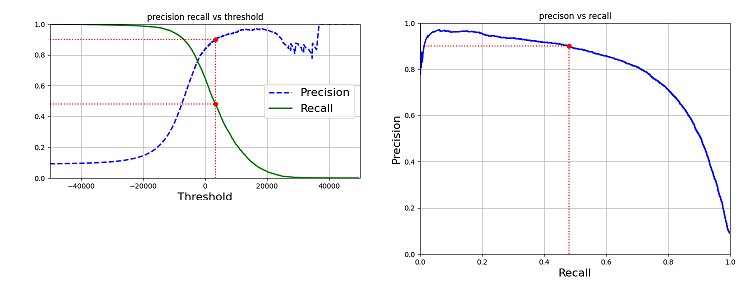
However, if we go back to the Never5Classifier model, precison/recall still does not show real performance. The precision always equals to 90% and recall always equals to 100%.
The ROC Curve
The receiver operating characteristic (ROC) curve is another common tool used with binary classifiers. It plots recall (true positive rate) vs FPR (false positive rate). There’s also a trade-off: the higher the recall (TPR), the more false positive (FPR) the classifier produces.
The following shows ROC curve of two different models:
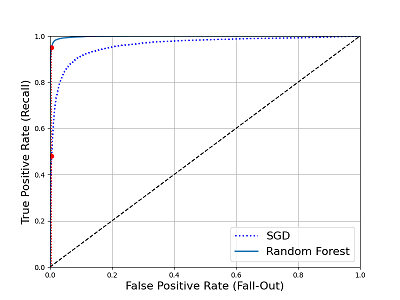
The Random Forest model performs better (the ROC curve is much close to the top-left corner).
There’s a concise metric to compare classifiers: the area under the curve (AUC). A perfect classifier will have a ROC AUC equal to 1, whereas a purely random classifier (the dotted line) have a ROC AUC equal to 0.5.
from sklearn.metrics import roc_auc_score
sgd_roc_auc = roc_auc_score(y_train_5, y_scores)
forest_roc_auc = roc_auc_score(y_train_5, y_scores_forest)

In [58]: (sgd_roc_auc, forest_roc_auc)
Out[58]: (0.9604938554008616, 0.9983436731328145)
As we can see, the Random Forest model has ROC AUC equal to 0.998. It’s better than that of SGD model.
Let’s move back to the Never5Classifier model. Recall always equals to 100%. But FNR always equals to 100%! It is an extremly bad performance. Its ROC AUC always equals to 0.
Which performance measure to use ?
The precison/recall and ROC metrics tell different aspects of the performance, thus we need both.
With the precison/recall metric, we can change threshold according to the actual requirment. And with the ROC AUC metric, we can compare different classifier and choose the best one.